WebSocket API Overview
RESTHeart CloudRESTHeart embeds a WebSocket server that exposes MongoDB’s Change Streams to web browsers and to any other HTTP/WebSocket client. With it you can build web or mobile apps that are notified of data changes in real time, without polling the server for updates.
WebSockets and Change Streams
Two standards do the work. The first is the transport between the client and RESTHeart:
The WebSocket API is an advanced technology that makes it possible to open a two-way interactive communication session between the user’s browser and a server. With this API, you can send messages to a server and receive event-driven responses without having to poll the server for a reply.
The WebSocket API
The second is how MongoDB tells RESTHeart what changed:
MongoDB’s Change streams allow applications to access real-time data changes without the complexity and risk of tailing the oplog. Applications can use change streams to subscribe to all data changes on a single collection, a database, or an entire deployment, and immediately react to them. Because change streams use the aggregation framework, applications can also filter for specific changes or transform the notifications at will.
Change Streams
RESTHeart joins the two: it opens the change stream on MongoDB and pushes every change event down to the WebSocket clients watching it.
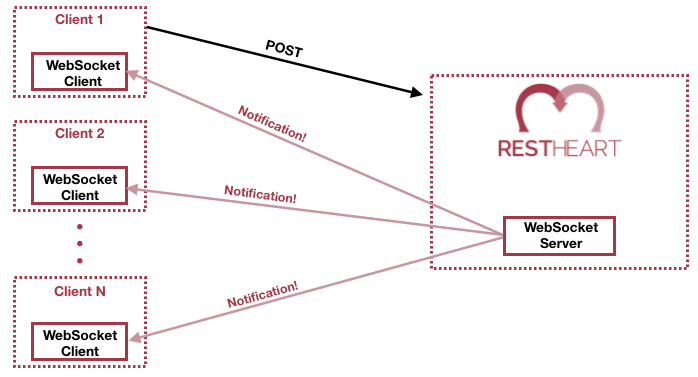
Exposing a Change Stream
Change streams are not opened by the client at will: they are declared by the developer as the streams collection metadata, and RESTHeart binds each definition to a URI under /<db>/<collection>/_streams.
{ "streams": [
    { "uri": "all",
      "stages": [
        { "_$match": { "_$or": [ { "operationType": "insert" }, { "operationType": "update" } ] } }
      ]
    }
]}
With the stream all defined on the collection messages, clients connect via WebSocket to ws://mydomain.com/messages/_streams/all and receive real time notifications of the data changes occurring in that collection.
The stages are a MongoDB aggregation pipeline over the change events, so they can filter and transform the notifications before they are sent — here, only inserts and updates are notified. See Change Streams for the full definition format, including why the operators are written $match and $or when the metadata is submitted through the REST API.
Filtering per Client
The same stream can serve different data to different clients. Stages accept variables that the client binds with query parameters at connection time, so one definition covers many filtered views:
GET /messages/_streams/mine?n=Andrea HTTP/1.1notify_when goes one step further and filters which connected clients receive each event, using a single MongoDB cursor for all of them. See Using Variables and notify_when.
Permissions Apply to a Stream
A change stream is a read, and the caller’s permission governs it as it governs the equivalent GET. Since 9.8.2:
-
the
readFilterof the matching permission is applied to the events: a caller limited to their own documents is notified about their own documents only, and events that carry no document — deletes — are not delivered when the filter is about the document’s own fields; -
an exclusion
projectResponseremoves those properties from the event, including fromupdateDescription.updatedFields; -
a
readFilterthat cannot be applied to an event ($expr,$where,$text) and an inclusionprojectResponse, which would strip the event’s resume token, refuse the subscription with403.
|
Warning
|
Before 9.8.2 neither was applied. A caller who could open the stream received every event on the collection, whatever their readFilter, and with the properties projectResponse hides. If you run an older version, restrict who may reach /_streams until you upgrade.
|
Filtering per client with notify_when is a convenience for the client, not a boundary: the variable it binds comes from the client’s own query string. See notify_when.
No More Polling
Because RESTHeart pushes the events, a client learns about a change the moment it happens — no polling loop, no requests that come back empty, no delay between the write and the notification.
Requirements and Lifecycle
|
Note
|
Change streams require MongoDB configured as a Replica Set. |
|
Note
|
When the streams collection metadata is modified, or the collection or the db is deleted, all related WebSocket connections are closed and the change streams are consequently updated.
|
WebSocket or SSE?
The same change streams are also available over Server-Sent Events, at the same URL, with Accept: text/event-stream instead of a WebSocket upgrade. Both transports share the same MongoDB cursor; SSE reconnects and resumes on its own, WebSocket gives you a full-duplex channel. The SSE vs. WebSocket table compares them feature by feature.
Next Steps
-
WebSocket API Tutorial — a step-by-step walkthrough, from creating the collection to receiving events in the browser
-
Change Streams — the
streamsmetadata and stream definition format -
Using Variables — parameterize a stream with
$varand query parameters